Introduction
In October 1990 the National Institute of Health launched the Human Genome project to research the building block sequence of proteins that a human being develops through life. The National Institute of Health suggests that over 30,000 genes exist and are responsible for the manufacturing of proteins (Doegenomes, n.d). Genes are the basis of heredity for living things.
What are proteins?
Coppel and Nossal (1984) suggested a useful definition of proteins as “Proteins are really cunningly designed molecular machines which eons of evolution have painstakingly built to be superbly efficient at one task each”. Examples of proteins include enzymes and antibodies. Antibodies enable the human body to combat germs and harmful intruders into the body. Enzymes act as vital catalysts to chemical reactions such as the breaking down of food and are also crucial in the replication process mitosis.
Expected Results
Lee (1991) suggests that the Human Genome Project (HGP) is “International in it’s scope, [and] is enormously expensive and, if successful, could lead to our ultimate control of human disease, aging and death.” (p1). The HGP was initiated in 1990 and was planned to last for 15 years. However, due to large advancements in technology, a revised completion date was set for 2003 (Doegenomes, n.d). By 2003 the Human Genome Project proposed the completion of six goals:
identify all the approximate 30,000 genes in human DNA,
determine the sequences of the 3 billion chemical base pairs that make up human DNA,
store this information in databases,
improve tools for data analysis,
transfer related technologies to the private sector, and
address the ethical, legal, and social issues (ELSI) that may arise from the project
(Doegenomes, n.d)
The results of the Genome project will provide scientists with more information about heredity and genetic diseases.
Genetic Diseases
Genetic diseases are a result of abnormalities in genetic information. Missing or malfunctioning genes prevent cells from performing necessary tasks or performing damaging tasks. Genes control the synthesis of vital proteins, which in turn control all reactions that take place inside the cell. These proteins or enzymes are the catalysts that encourage vital reactions to take place. Chemical reactions such as creating pigment in the retina allow the processing of images in the eye. When a person’s genetics fail, some genes lack the correct instructions of protein synthesis. This prevents certain chemical reactions from happening due to the lack of the enzyme catalyst.
An example of this missing chemical reaction is cystic fibrosis. Cystic fibrosis is an inherited disease that affects the lungs, pancreas and sweat glands. The lack of the necessary genes for perspiration and mucus creation cause excessive mucus in lungs to be created. Most cystic fibrosis victims succumb to respiratory problems by the age of 25 (Lee,1991,p185). In January 1989 the gene responsible for cystic fibrosis was found however forty different mutations are capable of causing cystic fibrosis (Lee,1991,p190). | 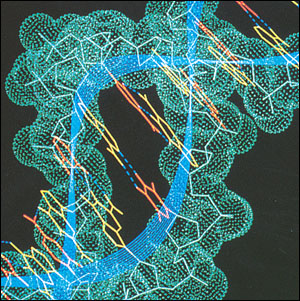
www.cis.upenn.edu/ compbiol/ |
To date, there are three thousand known inherited diseases, but as of 1991, only 3% of the responsible genes had been identified (Lee,1991,p185). Diseases such as cystic fibrosis, cancer, heart attacks, diabetes and Alzheimer’s can be attributed to genetic defects. |
Understanding the human genome allows the medical community to better combat genetic disorders and diseases as well as our further understanding of how human DNA and encoding works.
|
|


